
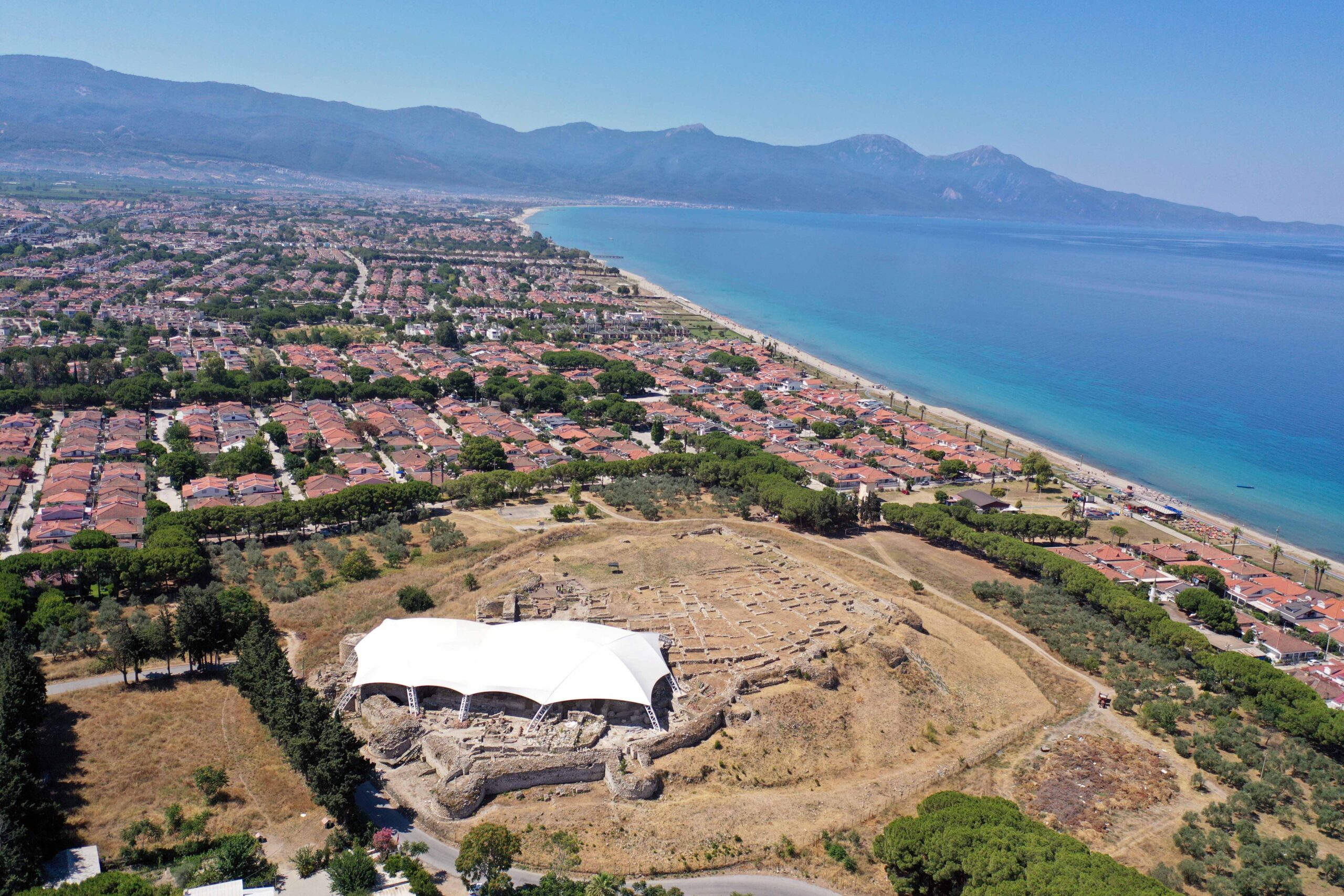
Excavations in an area believed to be the burial place of an Amazon woman during the Byzantine period in Kuşadası Bay are continuing to reveal its origins.
The site was named ‘Kadıkalesi’ during the reign of Sultan Murat II in the Ottoman Empire because it was given to a judge. Excavations are continuing under the leadership of Associate Professor Suna Çağaptay, a faculty member of the Department of Art History at the Faculty of Literature at Muğla Sıtkı Koçman University.
Kadıkalesi dates back 7,000 years. Excavations have uncovered prehistoric pottery, a mosque, a church, a hemispherical weight known as an ‘ağırşak,’ stone axes, Hittite-era statues, glazed ceramics from the 12th and 13th centuries AD, jewellery, an icon of a saint, lead seal impressions, and 800-year-old tile fragments bearing animal footprints.
Çağaptay and the team focused on areas that had not been excavated before in this year’s work. Çağaptay told an AA reporter that they had identified two structures dating back to the 13th century in this period’s excavations.
Explaining that they found pithos (storage container) remains in one of them and assessed that there was a storage point in the area, Çağaptay said: “It may have been used as a pantry.
“Since the pithos came in pieces, we will conduct a detailed analysis of what the remains are. We detected glass and metal slag in this area. We may be close to a production sector. Our area is already quite famous for this in the Byzantine period.
“The current data points more towards the Late Byzantine period. While I don’t want to be too bold, the current data suggests that we are looking at a production sector. We have not yet found anything other than small ceramic fragments related to the beyliks or the Ottomans.”
Çağaptay stated that, based on the ceramic, metal, and glass finds, this was an important trade centre, saying, “We can say that these ceramics, glass, and metals were produced and distributed, sold, and transported to the outside world from the port. Its religious and commercial structure may have been based on material culture.
“However, in our new studies, we are conducting new research to prove how this commercial material was distributed and sold.”
Images: AA