
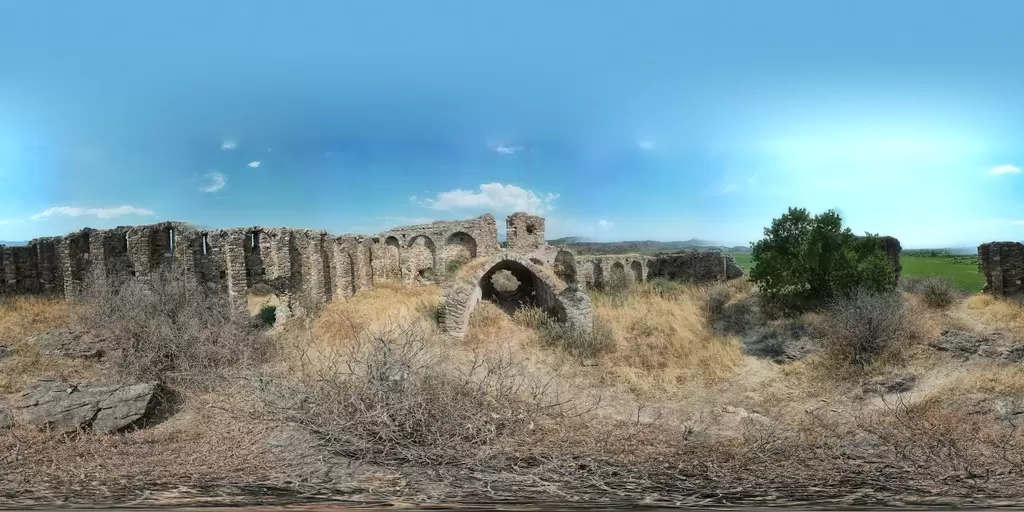
Myus Ancient City, a 40-minute ride from Didim, is a captivating archaeological site that, legend has it, was gifted away twice, its population afflicted with malaria, and its port on the Meander River which once could hold a fleet of 200 ships silted up so badly the city was eventually abandoned to its fate.
Getting there
To get to Myus from Didim, travel along the Didim-Soke road (D525) for about 30 kilometres, before turning right close to the Shell Garage and signposted for Sarikemer. It is another 6km on to Myus which sits close to Avşar Village.
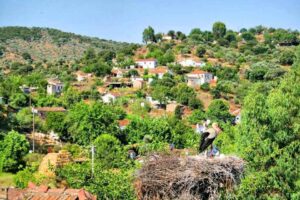 However, reports suggest the pot-holed road is narrow, yet it is possible to see Myus. However, to get there, drive on and leave the car 2 km past Avşar and walk the remaining 1.5 km to Myus. There are several signposts to Myus, but spaced far apart.
History
Legend has it that while one of the 12 cities of the Ionian League, it was the smallest and poorest given its location, close to the confluence of the Meander and Büyük Menderes rivers.
According to Greek geographer and historian Strabo, Myus was founded by Kydrelos, the son of Kodros, the legendary king of Athens. Its location was justified as it was on a small peninsula jutting out into the waters of the Latmian Gulf, now Lake Bafa.
 Myus experienced the boom and bust cycles during the rise and fall of empires and kingdoms across the ancient world. In 499 BC, a fleet of 200 warships anchored at Myus but fives years later, Myus participated in the Battle of Lade with only three ships.
When Themistocles, the Athenian hero of the Battle of Salamis in 480 BC, fell from grace and later exiled, he gained the friendship of the Persian king Artaxerxes. In 465 BC, he was gifted three cities to support his life: Magnesia for bread, Lampsakos for wine, and Myus for opson. Opson is derived from the Turkish word “katık” (katık), meaning “any food to be eaten with bread,” whether meat, fish, cheese, or olives. The provision Myus provided to Themistokles undoubtedly consisted primarily of fish.
Still relatively a free city in 390 BC, the city had territorial disputes with Miletus. By 201 BC, Myus was conquered by Philip V of Macedon, who then placed the city under the control of Magnesia on the Maeander, in exchange for food for his army.
 However by the second century, it appears Myus was under Milesian rule but even that didn’t save its future. Myus deteriorated to a point that its residents took all their belongings and statues and moved to Miletus. Myus was effectively abandoned. According to Pausanias, that only the Temple of Dionysus made of white marble remained.
A pointer to its demise was the fact that the silting of the Meander River meant that Myus was no longer accessible by sea. The gradual decline of Myus as an influential trading hub and the changing landscape made it increasingly difficult for ships. Others report the population also suffered from disease, possibly malaria caused by mosquitos inhabiting the marshes around Myus. Eventually, the slipped into obscurity.
What can be seen today of Myus?
During archeological excavations conducted at Miletus by Theodore Wiegand, several architectural elements of the archaic period were found and bore inscriptions related to Myus. These fragments, discovered in Miletus theater, the stadium and the Temple of Athena, confirmed the identification of ancient Myus with the ruins known as Avşar Kalesi.
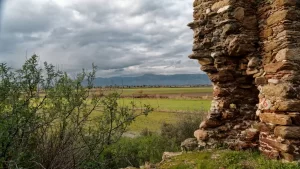 Myus also attracted archaeologists. In 1908, Wiegand conducted the first excavations on its territory. He found the fragments of buildings that were sent to Berlin. The most interesting of them are the reliefs depicting chariot races. In 1964 and 1966 work at Myus was led by Hans Weber, who cleared the area around the remains of two temples and created a plan of the old town.
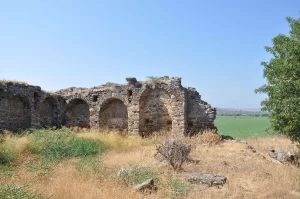
Today, the ruins of Myus are located on a small hill where the temples once stood. At the top, there are the remains of a Byzantine fortress from the 13th century AD. Below, on a slope, two terraces once supported the sacred buildings, of which little has been preserved. The city itself lay below, to the south-east of the temple hill.
The most important temple in Myus was dedicated to Apollo Termintheus. It stood on the higher of the two terraces. Below was the temple of Dionysus. Both of these buildings have almost completely disappeared, with the exception of marble foundations, because the most important excavated fragments were taken by German archaeologists to Berlin.
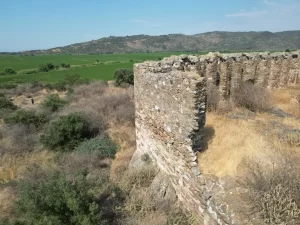
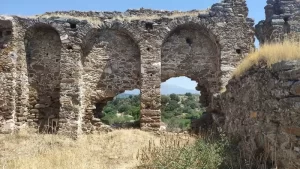 On the site there is also a fragment of the walls of the Archaic period, separating the terraces on the hill. The most impressive building in Myus, preserved in excellent condition, is a fortress built by the Byzantines in the period from 1200 to 1250 AD.
During a visit to Myus, it is worth to stop on the access road and look at the floodplains located below the hill. This area, formerly the part of the Latmian Gulf, is now home to many species of birds.
Additional information supplied by Turkish Archaeological News, and part of which is featured as a part of book Around Ephesus and Kusadasi: TAN Travel Guide by Izabela Miszczak