
Special feature by Laura Bower
If you’ve spent any time in Turkiye, you may have seen someone walking with a curious, pear-shaped black case strapped to their back. Inside lies a saz, Turkiye’s most iconic folk instrument, with a teardrop-shaped body, a long slender neck and seven shimmering strings. Played with the fingers or a plectrum, its sound can be hauntingly complex, sometimes echoing the work of several musicians at once.
The saz has travelled a long road. Centuries ago it came to Anatolia with the Oğuz Turks, carried on horseback from Central Asia. It became the voice of the aşıklar, poet-minstrels who sang of love, loss and village life, their verses drifting through mountains and plains. Today the saz is more likely to appear on YouTube than in a smoky roadside kahvehane. But the instrument itself is still made by hand, just as it always was.
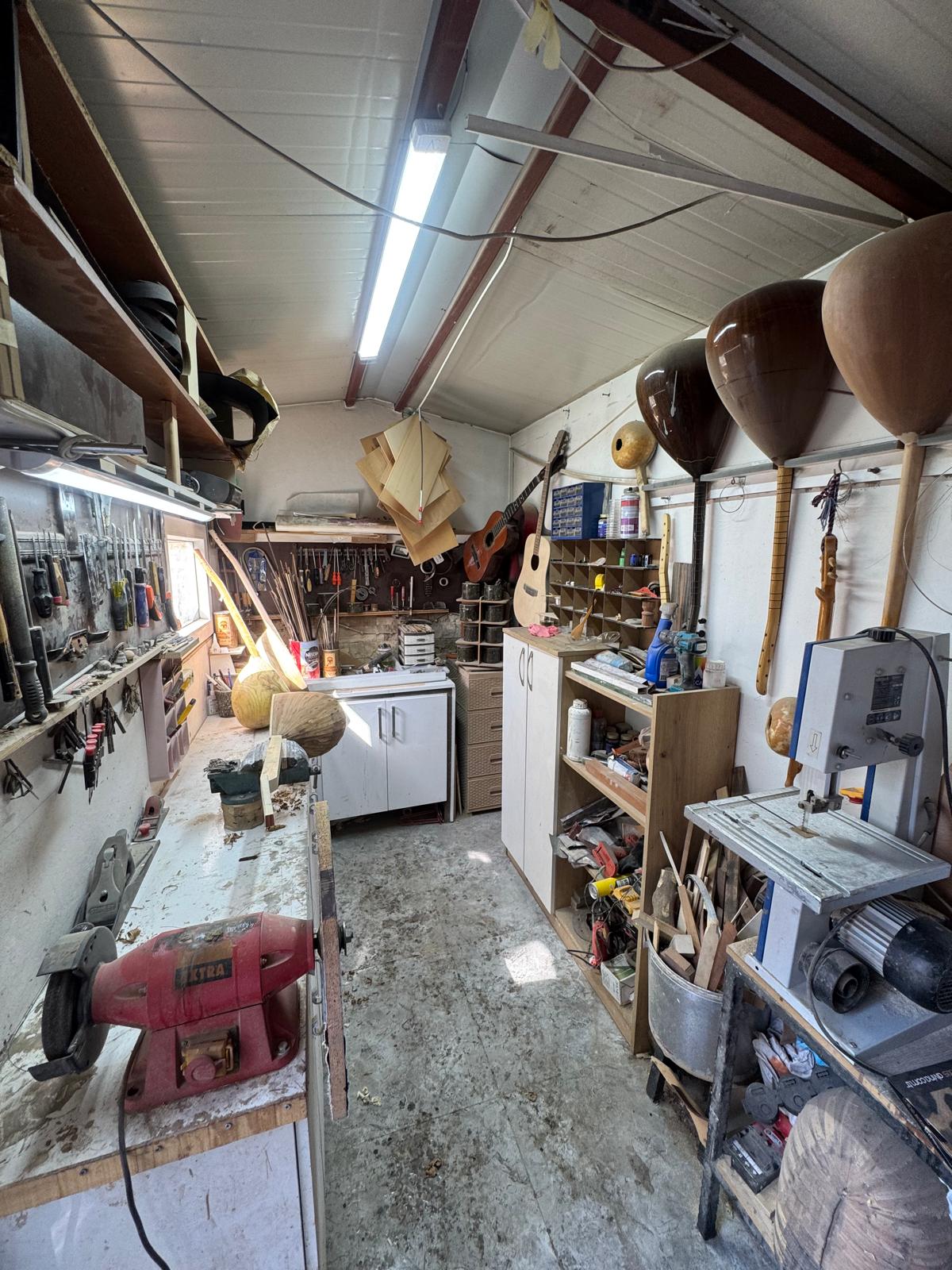
One of the people keeping that tradition alive is Metin Keskin, a master craftsman (usta) who makes and repairs saz in his Didim workshop.
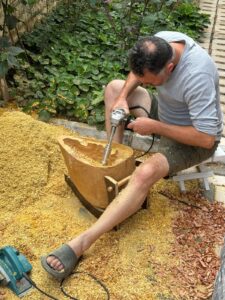 Metin’s journey began far from the Aegean coast in Tokat, a town in the lush inland Black Sea region. “When I was in high school,” he recalls, “my family couldn’t afford an instrument. I loved music, so I tried to improve an old broken saz by filing its neck with glass because I didn’t even have sandpaper.”
That determination led him to build his first saz from scratch. Later, he travelled with his father to Samsun to meet a master craftsman who was astonished at the young man’s self-taught creation and agreed to teach him the trade.
From that point on, Metin was hooked. “There’s a kind of mathematics in the saz,” he explains. “Every measurement, every cut changes the sound. Even two instruments with the same dimensions will sound different, because wood is alive.”
The Art of the Saz
The saz comes in two main types: carved (oyma) and leafed (yaprak). The carved version is hewn from a single block of wood, traditionally elder, hollowed into shape with an adze. It’s beautiful, but costly in both time and resources, as much of the log becomes waste.
The yaprak saz, on the other hand, is formed from 25 to 28 thin strips of wood shaped around a mould. This method, says Metin, is kinder to both the wallet and the forest. “The same tree that gives enough wood for one carved saz can give sheets for twelve yaprak ones.”
The body takes the longest to make. The wood must dry for five or six months before carving begins. The neck, frets, pegs and strings take another three weeks to complete. Metin uses power tools sparingly, preferring the traditional hand-carved methods that preserve the natural pores of the wood, crucial for creating the instrument’s rich tone.
Different woods serve different roles: elder for the body, maple or mahogany for the fretboard, oak or hornbeam for the neck. The face of the saz is usually spruce, a fine-grained wood found in northern Turkey, Europe and Canada.
 A Living Material
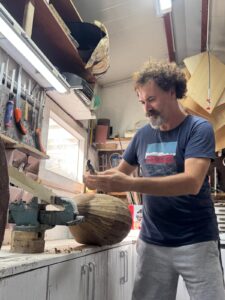
For Metin, every stage of making a saz is about understanding the life of the tree it came from. The process starts in autumn, when the sap has retreated and the wood holds less moisture. “When you cut a tree at the wrong time,” he says, “it will crack and the sound will never be good.”
Once cut, the log is stored upside down for weeks so that water drains naturally. The bark stays on until the wood dries, protecting it from pests. After that, the craftsman seals the ends with glue to prevent splitting, and the wood rests in a cool, dark place for months.
Even once shaped, the saz remains alive. It must be stored upright at room temperature, never hidden in a case or left in sunlight. “Wood changes with the air and temperature,” Metin says. “You have to respect it.”
Between Tradition and Innovation
Though he later became a police officer, Metin never stopped making saz. He built instruments in his apartment after work, crafting quietly while his children slept. Out of respect for his official position, he didn’t sign his instruments, but now retired, he plans to mark each one with his name, date and serial number.
He estimates he’s made somewhere between 1,000 and 3,000 saz over his lifetime, each with its own voice. Prices range from around 10,000 to 50,000 lira, depending on materials and sound quality. But for Metin, the real value lies in matching the saz to its player. “Every person has a different voice, arm length, finger span. I like to make an instrument that belongs to that person.”
 Even beginners, he says, should invest in a quality instrument. “If it’s hard to get a nice sound, people give up. A good saz encourages you to keep playing.”
The Spirit of Alevi Music
In Alevi culture, the saz holds sacred meaning. It’s not just an instrument but a vessel of memory, used to tell the stories and emotions of ordinary people. The aşıklar, the troubadours of old, sang of love, betrayal, exile and hope. Their songs carried the soul of Turkish life from one generation to the next.
“Saz music is the language of our people,” Metin says. “It tells our joys and sorrows. Every emotion can be played on a saz.”
For him, the craft is more than technical skill, it’s spiritual. “If you weren’t born into Alevi culture, you can still learn the craft, but you won’t make the same saz. The soul comes from our memories, from the lives of our parents and their parents before them.”
Making a saz, he says, also shapes the maker. “It teaches patience. You learn to understand wood, even though you can’t speak to it. You must feel what the tree wants to become.”
Keeping the Tradition Alive in Didim
In his Didim workshop, surrounded by half-shaped instruments and curls of fragrant wood, Metin also repairs other traditional instruments: violins, guitars, and Turkish wind instruments like the ney, zurna and mey.
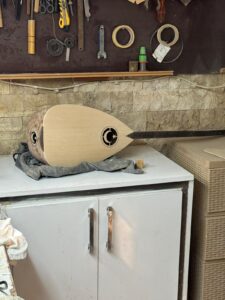 He’s proud to see young people taking an interest in the saz again. “Every Turkish home once had one,” he says.
“When people buy a saz for their children, they’re sharing their history.”
And just as the aşıklar once carried their songs on horseback from village to village, today the music travels through the internet and across borders even to the expat homes and beach cafés of Didim.
“It’s a connection to our past,” Metin smiles, running his hand over the smooth curve of a finished saz.
“When someone plays, they bring that history back to life.”