
If a full Wembley Stadium was the population of Türkiye, Didim’s residents would be just 99 people in the stands. Yet Didim provides over half of Türkiye’s under-18 international acrobatic gymnastics champions. Is there something in the water at Altınkum Beach?
Voices dropped in on a training session at Didim’s Youth and Sports Centre to find out why Didim’s children are taking Europe by storm.
 The Youth and Sports Centre is a new building not far from Didim Stadium, opened just last year. It still has some teething problems but it houses several million lira’s worth of gymnastics equipment, provided by the Turkish Federation of Gymnastics to support Didim’s incredibly successful acrobatic gymnasts and their coach Iryna Günal.
There is barely a pause when I enter the vast training area. The children are in the middle of a training session, focused on their elements, the movements and positions that make up an acrobatic gymnastic routine.
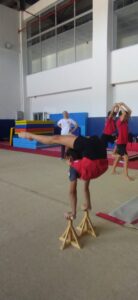
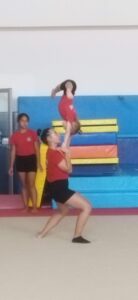
And if acrobatic makes you think of the circus, you’re not far off – these kids are balanced perfectly on each other’s shoulders, or heads, or palm to palm, or flying through the air, flung up by their team-mates who stand ready to catch them.

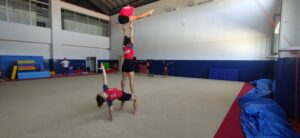 It looks effortless, until you see the deep concentration and tensed muscles. A mistake could be dangerous. But these young athletes are as well-trained as a team of commandos. They work together, each one confident in their role in the routine.
Astonishingly, none in this group are older than 15 and several are as young as six. They are preparing for their next international competition in Bulgaria next month. And making sure they are ready is their coach, Iryna Günal.
I know first-hand, or rather second-hand, how exacting a coach Iryna is, as my daughter trained with her from age four to eight years. At the time I ran a café with a children’s play area, and met Iryna when she brought her toddling twins to let off steam.
Finding out that Iryna had taught children gymnastics, I asked if she wanted to run a gymnastics activity at the café. I might not have dared to ask if I’d realised the calibre of the person I was speaking to.
Iryna was born in Belarus when it was still part of the Soviet Union. The state provided free coaching to encourage children to take part in sports, and at five-years-old a coach visiting her kindergarten picked out Iryna to try gymnastics. She loved the sport and had a talent for it, and at ten was offered the opportunity to specialise in a particular form, acrobatic gymnastics.
 Iryna was a highly successful athlete, winning over 100 medals for her country nationally and internationally, and No. 1 in the Belarus national team. She became a highly successful coach, with cupboards full of awards, including bringing home gold in the European Games.
But by the time we met, Iryna had left her sport back in Belarus, come to Türkiye, met and married a Turkish man and had two children, the toddlers who she brought to the café to play.
Iryna’s informal kids’ gymnastics group at Zebra café quickly outgrew the available space, and with the children flourishing under her direction, she opened a dedicated studio and her students began to win prizes.
Ten years later, Iryna and I meet over çay to talk about what she and her young students have achieved over the past decade and what she sees for the future.
“We make acrobatic gymnastics”, says Iryna, of her group of 23 competition-level under-16s. “My students and I are the first people in Türkiye opening this event of gymnastics. For the moment our three girls, Azra, Ada and Deniz are the first national team competitors, and I am the first national team coach for acrobatic gymnastics in the Turkish Gymnastics Federation.”
Iryna continues, “I was in love with acrobatic gymnastics since I was 10 until now, and I am happy now that in Türkiye I’ve had this possibility”.
Is this the same type of gymnastics performed by Simone Biles? “No, Simone Biles is doing artistic gymnastics. Artistic gymnasts compete by themselves. Acrobatic gymnasts work together as a team, making elements together, like pyramids or jumps, or lifting up the little girl, throwing her, and she is making in the air some somersaults or other elements, and the two girls who pushed her up must catch her and put her safely on the floor.”
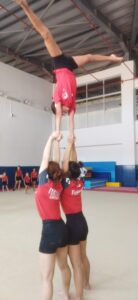 When Iryna started coaching in Türkiye, her group consisted of a handful of 4- to 8-year-old girls in the play area of a café, but Iryna coaxed perfect bridges and cartwheels even from this small group of small children, holding a micro-level competition with medals she had made especially for the occasion.
“Talented children are everywhere, and the best I can do is show them the way,” Iryna says, characteristically underplaying her role as the skilled coach bringing the best out of her young charges.
The children started performing choreographed routines in public, Iryna moved from the play area to a room above a bar, and then opened a dedicated studio, where her junior group still practices today.
Iryna and her team attracted attention from a larger studio in Izmir that invited them to compete with them as guest members, and then, as they began to win competitions, Iryna applied for certification by the Gymnastics Federation so she could send athletes to competition in her own right.
Despite Iryna’s history in Belarus in acrobatic gymnastics, there was no precedent for that discipline in Türkiye at that time, so initially she qualified as an aerobic gymnastics coach.
Finally this year, bowled over by the success of the children Iryna has trained, the Turkish Federation of Gymnastics invited her to become the first acrobatic gymnastics coach in Türkiye, and with just two months to switch disciplines from aerobic to acrobatic gymnastics, her first team won gold in their very first competition, representing Türkiye internationally in the European championships.
It would be a gross injustice to Iryna and her students if I gave the impression any of this was easy. Although my daughter stopped gymnastics before Iryna became formally qualified here in Türkiye, I remember the hoops Iryna had to jump through later to be recognised as a gymnastics coach by the federation, despite her storied history in Belarus as a gold-medal-winning international-level coach: three years of additional training and trips backwards and forwards to Ankara, she and her husband trying to balance family life with her young children, her coaching, and his car rental business.
And as for her wider family, the children that she coaches, the elite, competition group train in the new sports hall 3 ½ hours every weekday and on Saturdays as well.
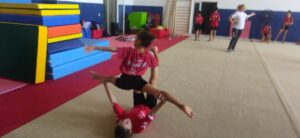 Don’t forget, these are primary and secondary schoolchildren. They go to school, they do their homework, they eat meals with their families, they sit (and often excel at) school exams, they play with friends – but they also train at least 21 hours a week, pretty much every week of the year, and travel to and win competitions throughout Türkiye and internationally.
And to make this all happen, there’s the admin and expenses. At the end of the training session, a couple of the parents hand over wads of notes. Not for the training, but for the professional competition leotards that have to meet specific standards.
I remember Iryna making our very first leotards by hand, measuring each child, sourcing the fabric, sewing 10 identical little costumes, hand painting the design on the front. Now, fortunately, she doesn’t have to make them herself, but there are still 23 competitors of different shapes and sizes, boys and girls, who need a new leotard for every routine.
There are also the travel logistics, making sure the arrangements are in place to get to each competition, transport, accommodation, briefing the parents, accommodating last-minute changes, making sure everyone is registered. And of course, passports –international travel isn’t something Turkish nationals can take for granted in the same way as British passport holders.
A Turkish passport sets the holder back between 9,000-14,000 Turkish lira and must be supported by often equally expensive visas for visits to many countries. These young athletes, however, are entitled to special grey passports when travelling abroad to represent their country. Much cheaper, and mostly visa-free, but still needing administrative effort to arrange.
Iryna is supported by her husband Ozgur, and old friend Lidya. Like Iryna and Ozgur’s twins, Lidya’s two daughters have earned their places in the elite competition team.
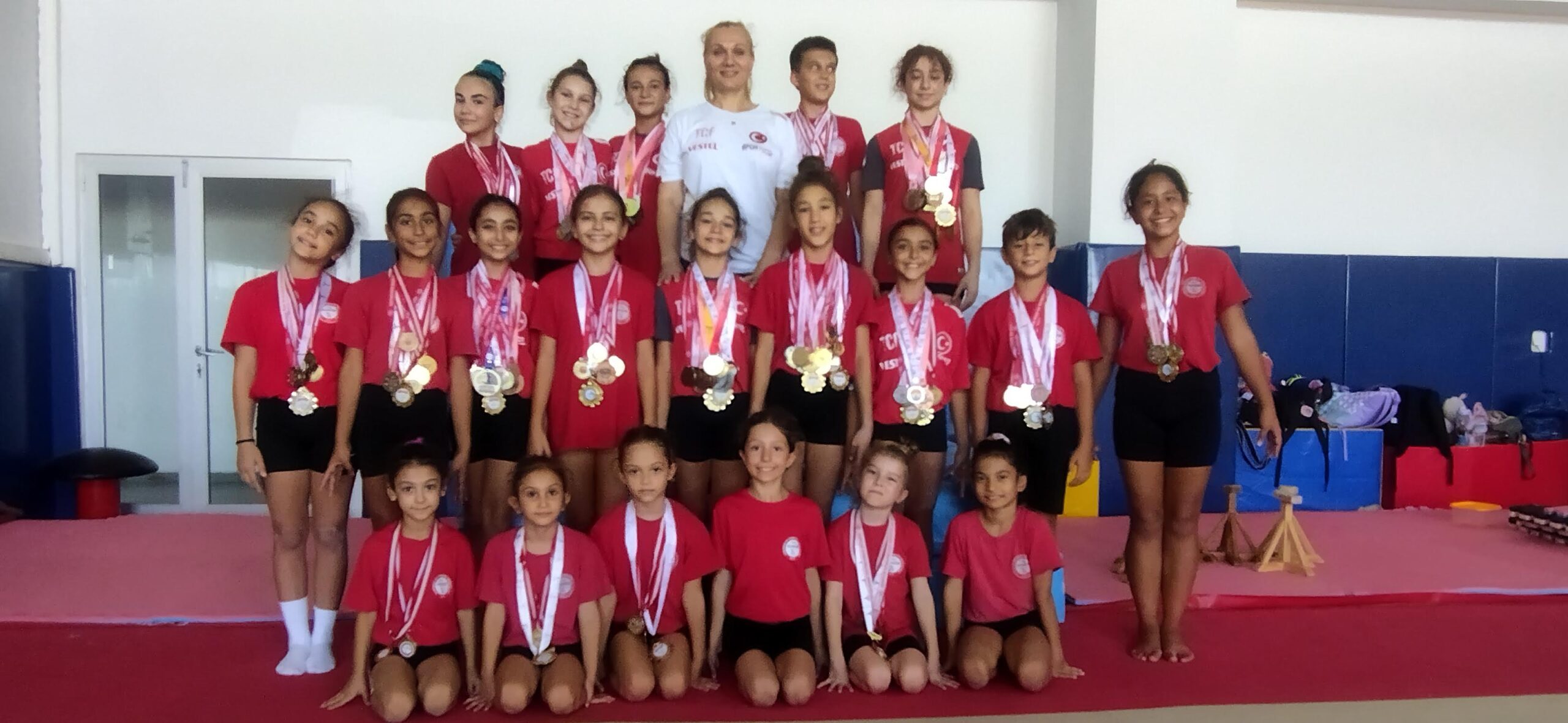
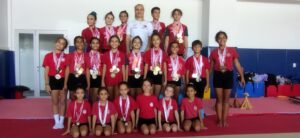 Of course, I can’t talk about this team without namechecking the children: Bahar, Yade, Ela, aged just 7, Teona (8), Defne (10), Ada (15), Jankemal (13), Furkan (9), Umsunay (11), Beren (13), Beren (11), İdil (10), Azra (15), Mira (13), Deniz (12), Nika (11), Ayşe (9), Nil (10), Liva (11), Efsun (11) and not forgetting Cemre (6), Aras, (11) and Bulut (6), who weren’t there when I visited.
Azra has the most medals, having racked up 30 in her gymnastics career so far, but the others aren’t far behind. When I ask the children to show me their awards, there are more clanking medallions than an army of Mr. Ts. There is also a younger cohort, the under 6s, who practise at Iryna’s studio with assistant trainer Pınar Armağan.
“If I was the president of the International Gymnastics Federation, for sure I would make acrobatic gymnastics an Olympic event,” says Iryna. From what I saw at the training session, it would be very popular – it’s dramatic, exciting, aesthetic, powerful, with beautiful choreography, energetic music, breathtaking acrobatics and fantastic costumes that would out-bling Strictly.
“I’m in love with acrobatic gymnastics. I’m really happy that now we have it in Türkiye,” concludes Iryna. Watch this space – first Didim, then Türkiye, next, the Olympics! If anyone can make it happen, Iryna Günal can!