
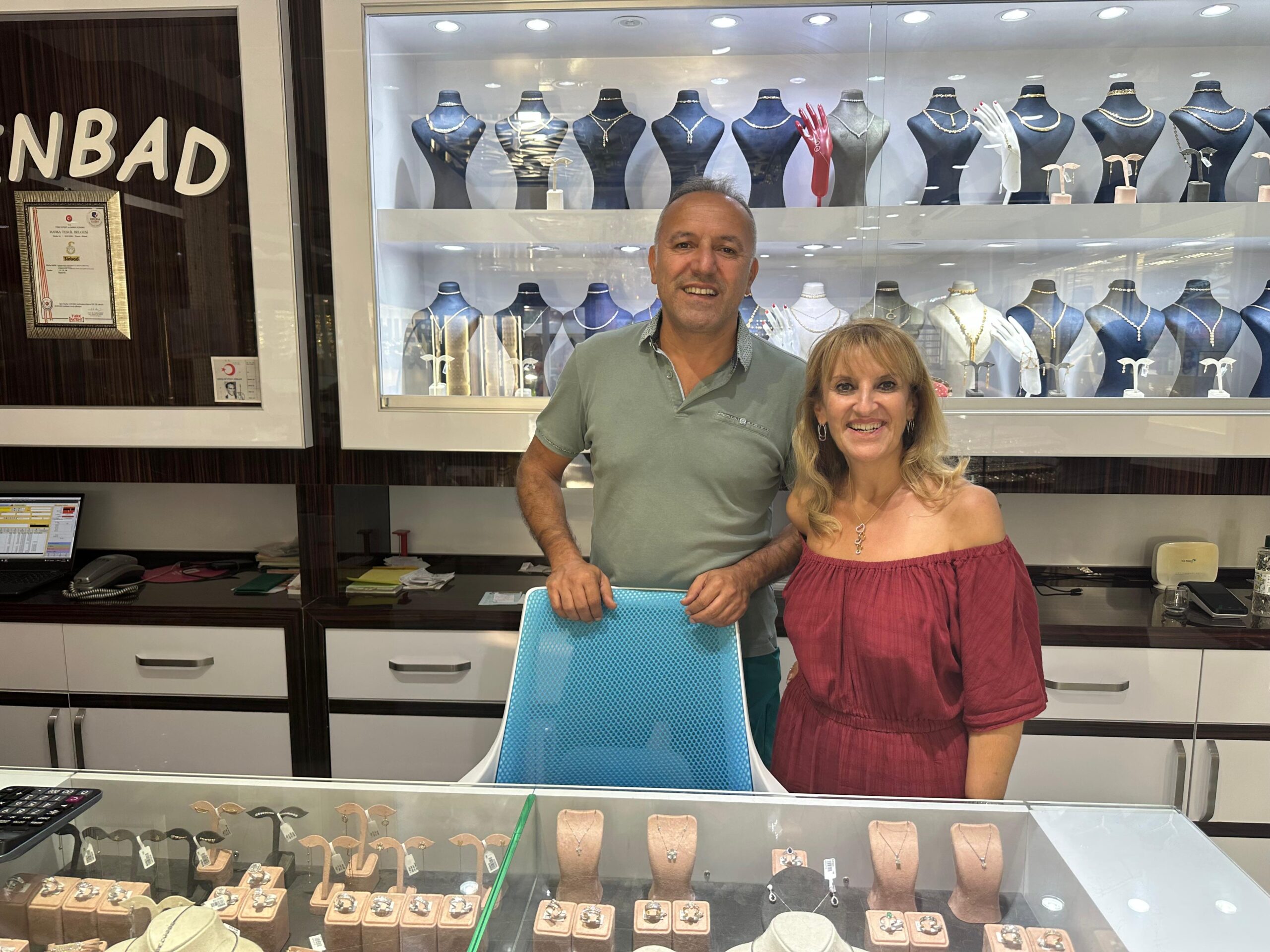
When Mus first arrived in Didim in 2005, she had no idea that the small seaside town would become her long-term home nor that the jewellery shop she opened with her husband, Sinan, would still be thriving two decades later.
“I always loved Türkiye,” she says, “and wanted to give it a go.” Born in Türkiye but raised in London after her parents moved there in the 1970s, Mus spent her childhood shuttling between cultures.
While her professional life in the UK was steady, where she worked as a civil servant for immigration, with an eye on a future posting at the British Consulate in Istanbul, her heart kept pulling her back east.
In the end, love and timing aligned. She met Sinan, a Didim local who had worked summers in a jewellery shop and once guided tours. Unlike many young Turkish men of the time, Sinan had no desire to move to Britain.
Mus, meanwhile, wanted to move to Türkiye. The solution? They planted roots in Didim and opened a jeweller’s. “Jewellery made perfect sense,” Mus says. “Sinan had experience, and I’ve always loved it.”
 Their first shop, a modest 18-square-metre space tucked under Pegasus Bar on the seafront, opened its doors in 2005. “It was a very small town back then,” Mus recalls. “Lots of Brits in summer, but winters were so quiet. We used to close when it got dark and shut completely for three months after Christmas, reopening on April 1st. Ours was the only shop open on that side in winter.”
The Didim of 2005 was worlds away from today’s bustling resort. “We had very few supermarkets, as Gima was the only one open all year,” she says.
Customers, too, have changed over time. “In 2005, 90% of our clientele were British,” Mus says. “Now it’s closer to 50/50, with British, local Turkish, and Turkish-European customers.” Each group has its own buying habits. “Turkish customers often buy 22-carat gold as an investment or what they call ‘under-the-pillow’ jewellery, because money devalues so quickly here. Gold, at least, holds its value.
“British customers are more interested in diamonds, which are much cheaper in Türkiye thanks to lower taxes and labour costs.”
Despite shifting demographics, the business remains solid, built on trust and reputation. “If there’s ever an issue with a piece, we sort it. Problems are rare, but they can happen with anything manmade. What matters is solving it, so customers leave happy. That’s why they come back.”
Some of those customers have been with them since the beginning. “Our very first client from 2005 still comes to us,” Mus says warmly. “She lost her husband, but she still visits, and now her children do too. Back then, people would just stroll past, pop in, have a chat. It helped that I was British as it gave people reassurance.”
It’s those personal encounters that fill Mus’s memory bank. She laughs as she recalls two of her favourite stories from their early days.
The first involves a dose of East London serendipity. “I was talking to a woman and recognised her accent straight away. She said she was from Hackney. I told her I used to work for the London Borough of Hackney. She said her husband did too, at the town hall. We went round the corner and there he was, Gabriel, one of the janitors I’d known back in London! Neither of us could believe it.”
The second is pure comedy. “I was chatting to a Scottish lady from Edinburgh. Her husband joined us and teased, ‘I bet you’ve got relatives there who run a kebab shop.’ I said, actually, yes — my uncle. He laughed, ‘I bet it’s called Mario’s.’ And I said, ‘As it happens, it is!’ He thought he was being funny, but he got every single detail right. The look on his face was priceless.”
Two decades on, Mus and Sinan’s business has grown, relocating from the seafront to the heart of town in 2009. Didim itself has grown too: busier, bigger, and far more connected than the small town Mus remembers from 2005.
And yet, she says, some things haven’t changed. “It’s still about people. Trust, relationships, memories. We still see familiar faces from 20 years ago. That’s the real treasure.”
As Didim celebrates 20 years of its local newspaper, stories like Mus and Sinan’s remind us just how much the town has transformed — and how the people who chose to make it home have helped shape it along the way.