
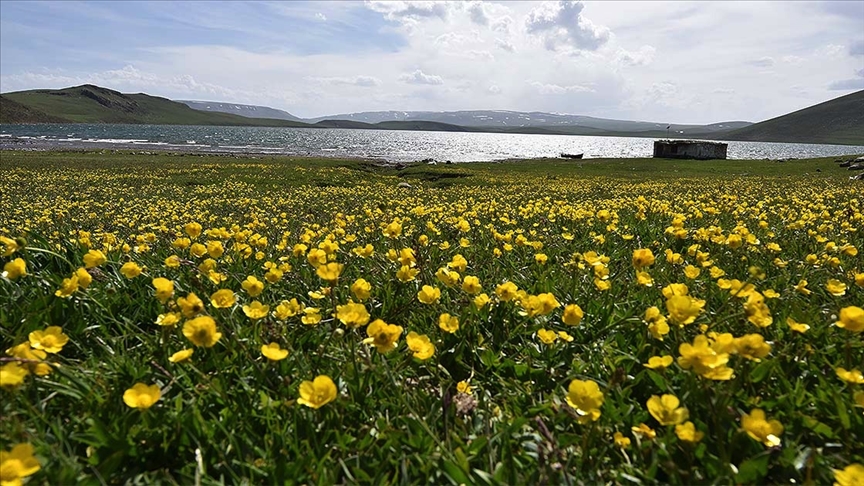
The last of the three fabled “cemre” is set to fall on March 5-6 ushering in the Turkic world’s harbinger of Nevruz, the festival celebrating the awakening of nature.
According to information from Anadolu Ajansi, the “cemre,” which means “fire, ember, glowing coal” and is believed to fall at weekly intervals, is thought to warm the air, water, and soil after the cold winter days.
The first of the “cemre,” which symbolize the warming weather and the approaching spring, fell into the air on February 19-20.
It is believed the second “cemre” (a traditional Turkish term referring to the first signs of spring) fell into the water on February 26-27.
The third and final “cemre,” known as the harbinger of Nevruz, the festival celebrated as the awakening of nature, falls to the ground on March 5-6.
“The falling of the first spring rains” also signifies, for those involved in animal husbandry, that the time is approaching when animals, which they couldn’t take outside due to the cold, will be able to graze in pastures; and for those involved in agriculture, it indicates that the time has come to cultivate the land.
Additional information from Turkiiye Today stated that the concept of cemre is not just an old tale; it is a time-honored tradition that has been passed down for generations of Turkish folklore, symbolizing nature’s slow but steady awakening from the cold months.
Cemre is a word of Arabic origin meaning “ember” or “burning coal,” and refers to the series of three mystical fireballs that descend from the heavens, gradually warming the air, water, and earth in succession.
While modern meteorology does not recognize cemre as a scientific phenomenon, the idea aligns with the natural warming process that takes place as winter gives way to spring.
The notion of cemre is closely tied to the old Turkic folk calendar, which divided the year into two main seasons: Kasim (winter) and Hizir (summer). Cemre marked the end of Kasim, signaling the gradual rise in temperature and the approach of the Hizir season.
The observation of cemre has long been crucial for communities engaged in agriculture and animal husbandry, helping them predict the best time to start preparing fields for planting.
Cemre is also connected to Nevruz, the Persian New Year, celebrated on March 21. The fall of the final cemre signifies that winter’s hardships are over, allowing preparations for the spring festivals to begin.
Another associated festivity is Hidirellez prominent in Turkish folklore, celebrated in May, which symbolizes the full arrival of spring and renewal of nature.
More details can be found here – https://www.turkiyetoday.com/culture/cemre-how-3-invisible-fireballs-signal-springs-arrival-in-turkish-folklore-121534?s=1