
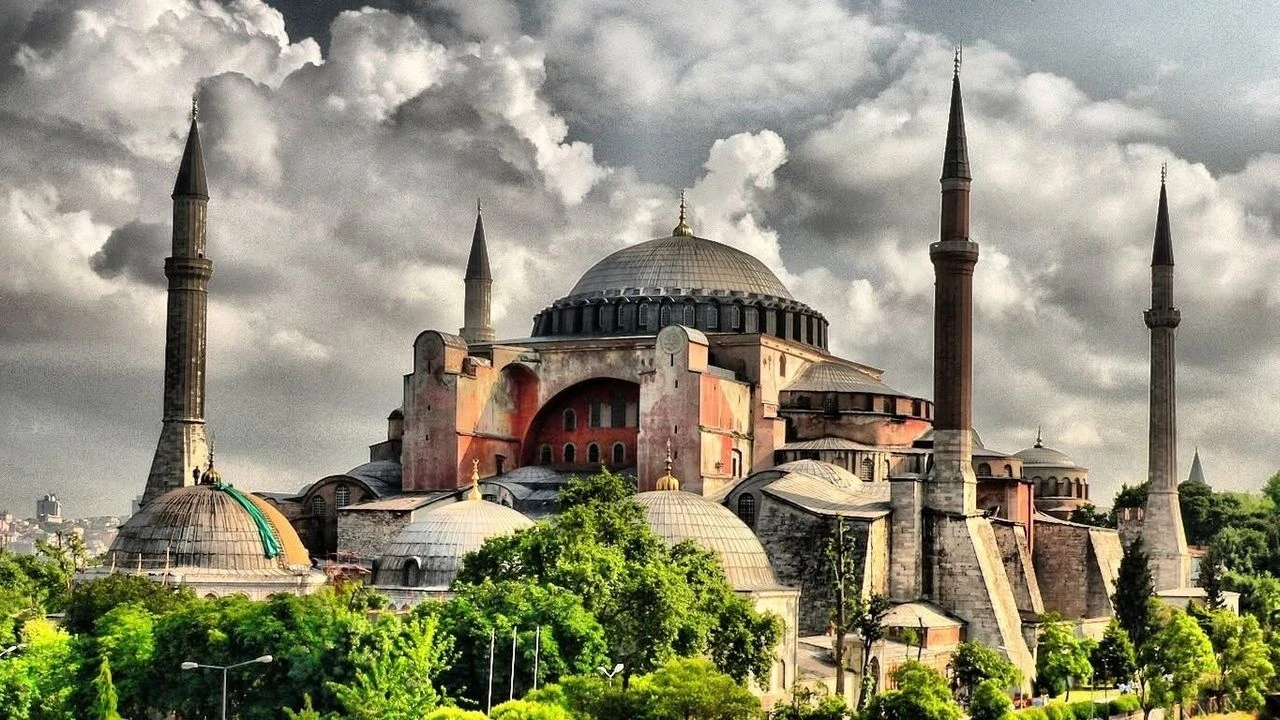
The Hagia Sophia is a world heritage site, but did you know that the two men who designed it were from Aydin?
 The two men were Isidorus, who grew up in the ancient city of Miletus within the borders of Didim, and Anthemius, who came from the city of Tralles in Aydin’s Efeler.
The architecture of this magnificent structure, known today as the Third Hagia Sophia and built between 532 and 537 AD by the Byzantine Emperor Justinian I, was undertaken by these two architects from Aydın, who were among the leading scientists of their time.
THE GEOMETRIC GENIUS FROM DIDIM: ISIDORUS OF MILETUS
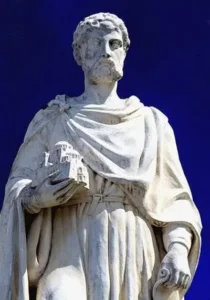 Born around 442 AD in Miletus, the ancient capital of Ionia, located in what is now the Balat neighborhood of Didim, Isidorus was one of the most important mathematicians, physicists, and architects of the Byzantine era.
Beginning his education in Alexandria and then deepening his studies in physics, mathematics, and geometry in Constantinople, Isidorus of Miletus focused particularly on three-dimensional geometry (stereometry), vault geometry, and building physics.
Commissioned by Emperor Justinian as one of the two main architects for the design of Hagia Sophia, Isidorus put his theoretical knowledge into practice, combining the longitudinal plan of a Roman basilica with a central dome system for the first time in the world with such great success.
MATHEMATICAL GENIUS: ANTHEMIUS OF TRALLES
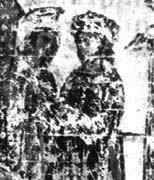 Another genius from Aydın who left his mark on Hagia Sophia was Anthemius, who was born in 474 AD in the ancient city of Tralles, located within the borders of present-day Efeler district.
Considered one of the most visionary scientists and architects of the Eastern Roman period, Anthemius of Tralles was one of the first to boldly apply mathematical thinking to architecture.
Commissioned to build an “unprecedented” structure in place of the old church destroyed during the Nika Revolt in 532 AD, Anthemius, together with his Milesian partner Isidorus, developed an architectural style never before attempted.
This remarkable partnership, established by two scientists from Aydın, resulted not just in a place of worship, but in a work of art that pushed the boundaries of engineering. This innovative design, combining a dome with a basilica, profoundly influenced both Byzantine and later Ottoman architecture, most notably that of Mimar Sinan.
The Hagia Sophia’s ability to stand for centuries despite all structural challenges is fundamentally based on the blend of Anthemius of Tralles’ bold mathematical calculations and Isidorus of Miletus’ genius in physics and geometry. This universal heritage, which blossomed in the land of Aydın, continues to live on in all its splendor in the silhouette of Istanbul today.
It was later converted into a mosque by Sultan Mehmed the Conqueror after the conquest of Istanbul in 1453. The site was then transformed into a museum in 1934, and regained its mosque status in 2020,