
Didim’s streets are lined with cafés and restaurants serving everything from pide, kebabs and pizza to burgers, steaks and chicken dishes aimed more specifically at foreign tourists, writes Laura Bower.
But some of the area’s richest culinary offerings are found a little further off the beaten track, in the countryside cafés and restaurants serving köy kahvaltısı – traditional Turkish village breakfast.
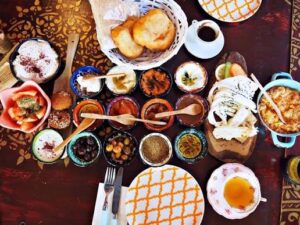 You may have seen pictures of, or perhaps been lucky enough to sit down at, a rustic table in the countryside, laden with countless little dishes. There might be chickens pecking around in the background – probably the source of the fresh eggs sizzling in the two-handled copper pan on the table in front of you.
There will probably be four or five different types of jam, made by the proprietor from locally grown produce. Have you ever tried aubergine jam? What about sweet chilli, tomato, carrot, walnut or fig? Don’t worry – there will certainly be a little dish of classic strawberry jam as well.
Milk from the village cow may have been churned and skimmed to produce homemade butter and clotted cream. Perhaps some of that milk has been simmered until thick and caramelised to make süt reçeli, a creamy, toffee-like syrup that goes perfectly on bread.
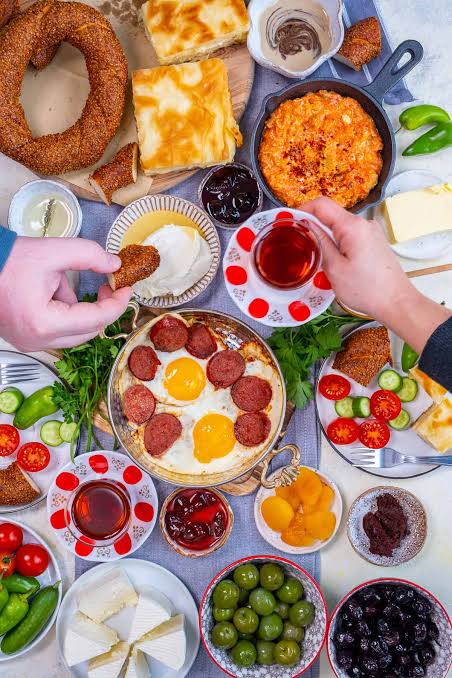
Back to the eggs. There might be three different options laid out on the table in front of you. First, those fried eggs sizzling in butter or olive oil, tinted a reddish-orange colour with pul biber, the classic Turkish seasoning made from flakes of sun-dried red chilli peppers. If you’re lucky, sharing the pan might be slices of sucuk, a spicy sausage resembling merguez and adding an unbeatable umami flavour.
There may also be boiled eggs – probably hard-boiled, although if you prefer them soft, you can ask for them rafadan – and, as a real treat, menemen. You might be familiar with its Middle Eastern cousin, shakshuka, but in this Turkish version, as with so many Turkish dishes, the quality of the ingredients is brought to the forefront by the simplicity of the recipe.
Gently sautéed onions and green peppers are simmered with grated tomatoes and a pinch of pul biber, with eggs stirred in once the other ingredients are ready. A little salt and black pepper is all this traditional dish needs.
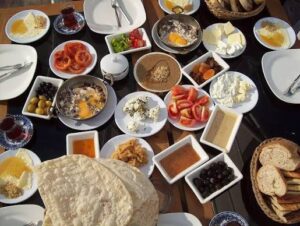 You’ve never really sat down at a Turkish breakfast table if you haven’t been offered several types of savoury homemade pastry. Su böreği is made with white cheese layered between layer upon layer of delicate pastry, each sheet briefly cooked in boiling water before being draped into the baking tin and finished in the oven until the top is golden and crisp and the middle practically dissolves in your mouth.
There may also be crispy pastries filled with leafy greens that grow almost like weeds in the fields – ebegümeci, or mallow, for example. People still forage for these and other wild greens, which offer plenty of nutritional benefits as well as flavour.
Peppery rocket and cress are often served at breakfast too, alongside sliced cucumbers sprinkled with salt and wonderfully ripe tomatoes. These simple ingredients are packed with vitamins, minerals, antioxidants and fibre – not a bad way to start the day!
Of course, those little plates will also contain several different types of cheese. There will certainly be the feta-like cheese simply known as beyaz peynir, or white cheese, and perhaps also lor, a low-fat, high-protein crumbly cheese. Labne is a soft, spreadable cream cheese, while kaşar is probably the closest Turkish equivalent to cheddar. But just as Britain has its regional cheeses, Türkiye has an extraordinary variety of cheeses, each reflecting the region where it is made.
If all of that sounds a little too wholesome, don’t be surprised if you also find a plate of home-cut chips sharing the table! Or pişi, airy puffs of deep-fried dough, both of which are inevitably popular with Turkish children.
And no Turkish breakfast is complete without olives, the Aegean’s most prized commodity. Olive trees grow all over the region, and you’ll see people harvesting their bitter fruit by shaking the branches or even gently whacking them with sticks to knock the ripe olives onto sheets of cloth spread beneath each tree.
Some of those olives will be pressed into olive oil, while others will be cured over weeks to draw out their bitterness. They may be flavoured with lemon or beetroot, adding a citrusy bite or a beautiful purple hue. Like them or hate them, olives are the pride of the Turkish breakfast table, and olive oil is one of the cornerstones of the Aegean diet.
So next time you have a few hours to spare, make your way out into the countryside, make sure the teapot is on the stove, and get stuck into one of the real treats of Turkish life: köy kahvaltısı – Turkish village breakfast.