
As you drive along the coast past Mavişehir and north out of Didim, you can see unfolding in front of you a huge flat delta of sandbanks, reeds and rivulets, writes Laura Bower
A headland rises up in the distance, one end sloping steeply into the sea, framed by an island looming in the distance, the other folding up into mountains. This is where the Büyük Menderes River meets the Aegean Sea, and where migrating flamingos and pelicans make their homes for the winter and spring.
Following the road, first inland and then out again towards the coast, takes you through the villages of Akköy and Balat and onto the plain of Söke, lush with cotton and sunflower fields.
That ruler-straight road heads due west, back out to the headland you saw earlier. It forks at one point, with one fork continuing north and the other heading through another village, then starts to twist as it rejoins the sea, dipping left and right around the tall reed beds, until you reach a white wooden bridge with a collection of signposts. One of these signposts points to our destination, Eski Doğanbey.
Eski Doğanbey is a historic stone village dating back to centuries before the foundation of the Turkish republic. It was home until 1924 to the Rum, an ethnic Greek community whose roots stretched back through the Byzantine era.
The founding of the republic of Türkiye saw state borders drawn through the Aegean Sea. The Turkish-speaking people from the side of the Aegean that’s now Greece swapped lives with the Greek-speaking people from the side that’s now Türkiye. Each community left the villages their ancestors had called home for generations and made a new start hundreds of miles away across the water.
Voices visited Doğanbey and spoke to Hüseyin Bingöl, the proprietor of the Müze Kafe, born in the village to one of those Turkish families who migrated in the 1920s from Thessaloniki, in northern Greece.
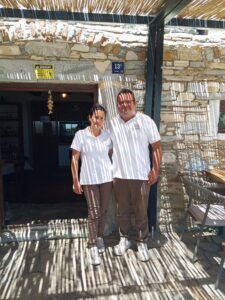 The village was known as Domatia for 400 years, and Hüseyin’s family-run café is housed in Domatia’s former hospital building. His family serve village breakfast, coffee and cakes handmade by Hüseyin’s wife Zeynep, and beer or wine with bar snacks in the evenings.
When Doğanbey was still Domatia, the locals made wine from the grapevines they tended on the mountain slopes, but the wine served in the café comes from Antalya. The new residents, used to fishing and farming olives in their homeland around Thessaloniki, had no experience of growing grapes or fermenting wine, so the grapevines around Doğanbey withered.
For 60 years the new villagers of Eski Doğanbey travelled down the hill to fish, farm olives and cultivate cotton on the Söke plains, and then in the 1980s left the village permanently.
The historic stone buildings were hard to maintain, and the villagers of Doğanbey were allocated a new village a couple of kilometres away. Doğanbey became Eski, or Old, Doğanbey, and the new village, imaginatively, Yeni, or New, Doğanbey. The new village is a lot easier to get to and develop, close to the coast, everything flat.
Eski Doğanbey is built into a natural jagged crescent shape formed where one of the smaller of the Samsun Mountains is split in two by a deep gully carved over millennia by meltwaters running down to the sea.
The streets are craggy and narrow, paved unevenly with rough-hewed stones and tightly framed with flowering trees: better suited to a donkey than a car. From a distance you can see the houses are arranged in tiers, like a very steep amphitheatre, and Hüseyin explained that every single building in Eski Doğanbey has a view out to the sea.
Now, 100 years after the original residents left for Greece, and 40 years after the newer ones left for the coast, another generation is breathing new life into Eski Doğanbey: people seeking out culture and beauty, wealthy enough to afford to renovate the historic stone buildings according to the village’s protective planning regulations.
The inconvenience of the uneven streets and the lack of development opportunity is a feature, not a disadvantage. Eski Doğanbey is situated in a national park that encompasses tens of thousands of hectares of forests, canyons, caverns, mountains, valleys, beaches and the delta of the Büyük Menderes river.
The village’s museum is part of the Ministry of Agriculture and Forestry, and eerily strives to convey the richness of the national park’s wildlife through taxidermy.
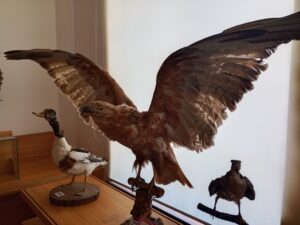 The result is both unsettling and effective. The stuffed remains of Dilek Peninsula’s birds and animals tell a cautionary tale of how important the national park is and how humans form the greatest danger to the area’s beautiful wildlife.
Until 1966 the area around Doğanbey was unprotected, and hunters took advantage of the freedom to bag trophies from wild deer to big cats.
Astonishingly, this part of Türkiye’s Aegean coastline was home, in living memory, to the Anatolian leopard. It preyed on deer, goats, wild boar and smaller mammals and birds from its place at the top of the food chain, but was no match for trophy hunters.
The last known local leopard was caught in the mountains around Bafa Lake in the 1950s, and while suspected traces of living leopards were apparently seen here until as late as the 1970s, there have been no traces or sightings for the last 40 years and the Anatolian leopard is assumed to be regionally extinct. All that remains is a tattered leopard skin, a bit forlorn among the other museum exhibits.
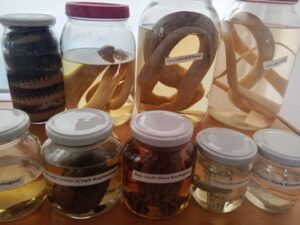
Other occupants of the Doğanbey museum include the skeleton of a Mediterranean monk seal, which is also critically endangered, and native to the area; a stuffed flamingo, a stuffed pelican, and a stuffed porcupine the size of a medium-sized dog.
There are hosts of other birds and also jars of small reptiles and amphibians, as well as a couple of staged scenes placing the creatures in replications of their natural habitats. The walls are lined with beautiful photographs of plants of the area, some of which are found around Doğanbey and nowhere else in the world.
Doğanbey is a beautiful village with a fascinating social and natural history, and remarkably it’s completely free to visit.
The whole place is a testament to the fragility of life and certainly doesn’t get as much attention as it deserves, so when you’re planning a day trip from Didim, try a tour of Eski Doğanbey, and make sure you stop for refreshments at the Müze Café with Hüseyin and his family!