
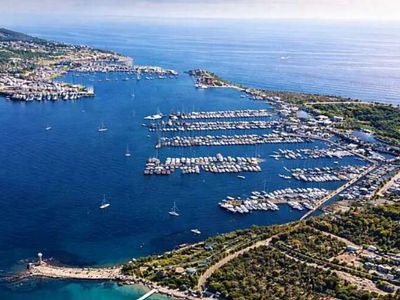
Two diverging projects featuring a huge marina and a port expansion have emerged in the region.
The Kaplankaya Project, one of the largest luxury tourism investments in Türkiye, set to be built in Milas district has received environmental impact assessment approval for its marina with a capacity of 256 boats and accommodation area with 51 beds.
The new milestone of the Kaplankaya Project, which was initiated approximately 20 years ago, is set to be one of Türkiye’s largest luxury tourism investments. Environmental Impact Assessment (EIA) approval has been granted for the Kaplankaya Yacht Harbor Revision project, which will be implemented by Kaplankaya Marina Management Tourism and Trade Inc.
 According to a report by Muğla Newspaper, the marina to be built in Bozbük will have a total capacity of 256 boats. The project, planned with an investment cost of approximately 651 million TL, will also include a 51-berth yacht accommodation unit, a commercial area exceeding 20,000 square meters, a yacht club, and a heliport.
Kaplankaya Marina was first mooted in 2007 and included in the Kaplankaya Master Plan, which had a total investment of $1.5 billion.
EIA) approval was granted in 2011, and construction work on the site began in 2014. The marina project was revised to meet technical requirements. According to the EIA file, the primary purpose of the Kaplankaya Yacht Marina will be to serve the boat traffic generated by the hotels, residences, and other tourism investments operating within the Kaplankaya Tourism Investment Project.
In this respect, the marina is planned to function as a complementary facility to the Kaplankaya Tourism Destination, rather than directly competing with existing yacht marinas in the region.
The first hotel investment in Kaplankaya opened in 2016 and later became the Six Senses Kaplankaya brand.
Third pier plan for prompts concerns
Following the “Blue Forests” discussion in Kuşadası, which addressed the protection of marine ecosystems, the 3rd Pier project has become a subject of debate due to its potential impact on seagrass meadows.
Ecosystem Protection and Nature Lovers Association (EKODOSD) warned that the dredging to be carried out in an area of approximately 51 acres poses serious risks to the marine ecosystem.
The dredging project raised at the 3rd İskele Environmental Impact Assessment meeting increased concerns about environmental risks. EKODOSD, drawing attention specifically to Posidonia oceanica seagrasses, called for action to be taken in accordance with scientific data.
At a programme organized as part of EKODOSD’s Wednesday Talks, the ecological and economic importance of seagrass meadows was discussed, while on the same day, the potential impacts of the Kuşadası Port Capacity Increase and Dredging Project’s 3rd pier on the marine ecosystem were also debated at the Environmental Impact Assessment (EIA) meeting.
 Ebru Çelik, WWF-Türkiye’s Marine and Biodiversity Expert, was the guest speaker at the talk. In her presentation titled “Transforming Alternative Income Sources for Blue Forests and Coastal Communities,” Çelik discussed the role of marine ecosystem conservation and coastal communities in sustainable development.
The event, held in Dilek Peninsula National Park, one of the pilot regions in Türkiye for the Blue Forests Project run by WWF-Turkey, assessed the relationship between alternative livelihoods for coastal communities and nature conservation.
The program specifically highlighted the role of seagrass meadows and other blue carbon ecosystems in combating climate change.
During the meeting, it was stated that the Pier project includes plans to construct a pier 300 meters long and 15 meters wide, and to carry out dredging in an area of approximately 51 acres. The studies are expected to yield approximately 113,000 cubic meters of dredged material.
Some NGOs and political party representatives who attended the meeting expressed their views on the potential impact of the project on Kuşadası’s urban identity and environmental values. In particular, criticisms were raised regarding the lack of sufficient explanation about where and how the material resulting from the dredging would be disposed of.
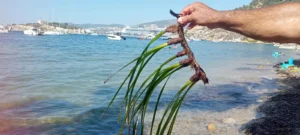
At the centre of the environmental debates were the seagrass species Posidonia oceanica.
In its assessment, EKODOSD pointed out that Posidonia oceanica, an important seagrass species of the Mediterranean, is found in the area where the seabed dredging will be carried out.
It was stated that seagrass meadows provide feeding, breeding, and shelter areas for numerous marine organisms, and it was emphasized that these ecosystems play an important role in combating climate change by storing carbon in their tissues and sediments for long periods.
It was stated that turbidity, sediment transport, and sediment accumulation that may occur during bottom dredging could reduce the light penetration of seawater, which could negatively affect the dredging area as well as the surrounding seagrass meadows.
EKODOSD President Bahattin Sürücü stated that a balance must be struck between economic activities and nature conservation, but this balance should not be achieved at the expense of irreversible ecological damage.